
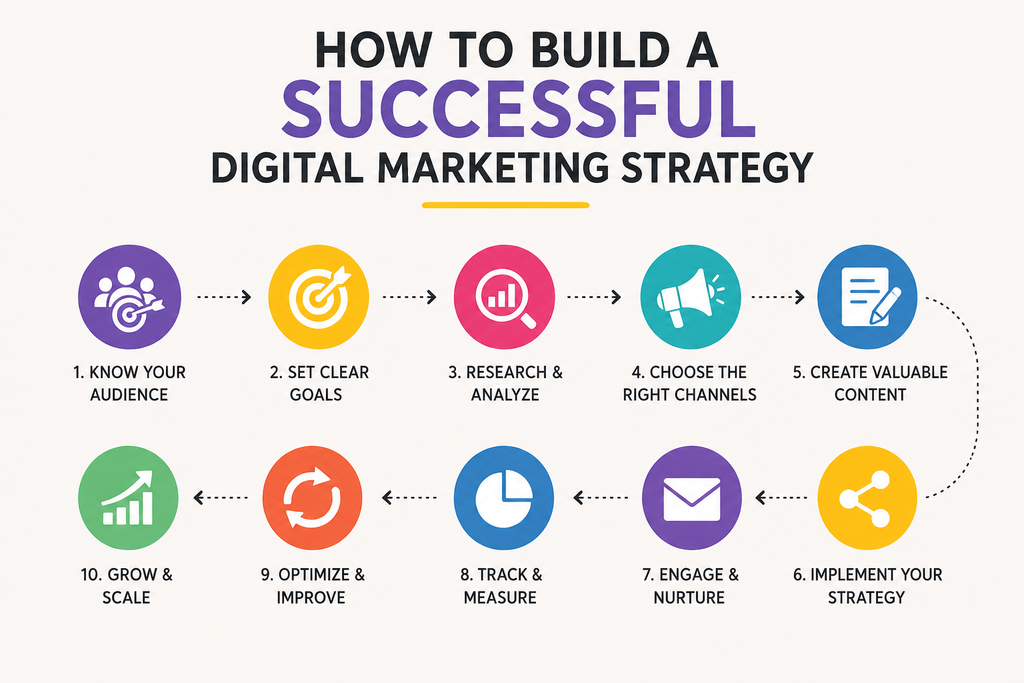
A digital marketing strategy is not simply about posting on social media or sharing content online. It is about understanding the goals of a business, understanding how the business operates, and creating a proper plan to achieve those goals.
A digital marketing strategy is a clear plan that determines how a business will use digital channels such as Google, social media, websites, email, and online ads to reach its target audience and achieve its business goals.
1. Set Clear Marketing Goals
Before starting a successful digital marketing strategy, the first step is to understand what type of business you have and decide what you want to achieve through digital marketing.
For example:
*Increase website traffic
*Generate more leads
*Increase brand awareness
*Improve Google search rankings
The marketing goals of every business will be different. Some businesses may focus on increasing brand awareness, while others may aim to increase sales or improve customer engagement.
Setting clear marketing goals helps a business choose the right digital marketing strategies and measure its progress effectively.
2. Understand Your Target Audience
Knowing your target audience is one of the most important parts of digital marketing.
You need to understand who your ideal customers are and what they need. Try to find out information such as:
Age
Location
Interests
Occupation
Buying behaviour
Problems and needs
Preferred social media platforms
Online search habits
For example, if you are marketing a beauty product for young women, Instagram and short-form video content may be useful platforms.
3. Analyse Your Competitors
Before creating your digital marketing plan, research your competitors.
Look at what they are doing online. Check their websites, social media accounts, advertisements, blogs, and search engine presence.
Ask yourself:
What type of content are they creating?
Which social media platforms are they using?
What keywords are they targeting?
What are their strengths?
What are their weaknesses?
How can your business be different?
Competitor research can help you identify opportunities and avoid repeating the same mistakes.
The goal is not to copy your competitors. Instead, use their strategies to understand the market and create a better approach for your own business.
4. Build a Strong Website
Your website is an important part of your digital marketing strategy. It is often the first place where potential customers learn more about your business.
A good business website should be:
Easy to navigate
Mobile-friendly
Fast-loading
Secure
Easy to understand
Visually attractive
Optimized for search engines
Your website should clearly explain what your business offers and how customers can contact or purchase from you.
You should also include clear calls to action (CTAs) such as “Contact Us,” “Buy Now,” “Get a Quote,” or “Book Now.”
A well-designed website can help turn visitors into leads and customers.
5. Focus on SEO
SEO is an important long-term digital marketing strategy because it can bring organic traffic to your website.
Search Engine Optimization (SEO) helps your website appear higher in search engine results when people search for relevant information, products, or services.
Some important SEO practices include:
Finding relevant keywords
Creating useful and original content
Optimizing page titles and meta descriptions
Using proper headings
Improving website speed
Making the website mobile-friendly
Building quality backlinks
Improving internal linking
For example, if you provide digital marketing services in Kerala, keywords such as “digital marketing services in Kerala” or “digital marketing agency in Kerala” may be relevant to your strategy.
However, avoid keyword stuffing. Your content should be written naturally for people first and search engines second.
6. Create Valuable Content
Content marketing is another important part of a successful digital marketing strategy.
Your content should provide value to your audience instead of only promoting your products or services.
You can create different types of content, including:
Blog posts
Instagram posts
Reels
YouTube videos
Infographics
Guides
Case studies
Customer testimonials
Educational content
For example, a skincare brand can create content about skincare routines, common skincare mistakes, and product tips.
Useful content can build trust, increase engagement, and encourage people to choose your brand.
Lorem ipsum dolor sit amet, consectetur adipiscing elit. Ut elit tellus, luctus nec ullamcorper mattis, pulvinar dapibus leo.